Your business has the information. We find out why it isn't becoming the outcome, and fix that.
Biomavens is a strategy and technology consultancy focused on AI and decisioning. Most organizations already have the data, the analysis and the tools. What they are missing is the point where a decision turns into an action — in the market, in the operation, or in the product. We find where that break is and build what closes it. Where the blocker is a person rather than a process, we bring Anthrocentrix, the decision-activation engine we originated.
Three places a decision fails to become an outcome. Three practices.
Many engagements are two of these. Some are all three.
The last mile of AI isn't intelligence. It's realization.
Models recommend. Dashboards display. Workflows notify. None of it proves a person changed what they did. The failure point is usually human — trust, control, effort, loss-aversion, ambiguity, readiness, organizational friction.
Three failure modes drive the pattern
The agent acts on stale or incomplete data.
The agent has the wrong permissions or no audit trail.
Humans overtrust the agent, stop reviewing, and can no longer supervise it effectively.
The first two are infrastructure problems the market is solving. The third is a human problem, and it is the one most often left unsolved.
When the blocker is a person, not a process.
Most of what we build is ordinary: a workflow that was missing, a rule that lived in someone's head, two systems that never talked. But in every operation there is a class of decision where the information is right, the recommendation is right, and the person still doesn't act. That is what Anthrocentrix is for.
Anthrocentrix™ — the decision-activation engine. Patent pending.
Gartner defines a decision intelligence platform as software that supports, augments, and automates decision making. Read it twice — not one word about whether a human does the thing. The category ends at the decision; the action is the space it leaves empty. Even next-best-action still only recommends. Anthrocentrix names the human factor most likely to block the decision, matches a change to that specific cause, and measures whether the person actually did it — the same loop, wherever people decide.
Play the live demo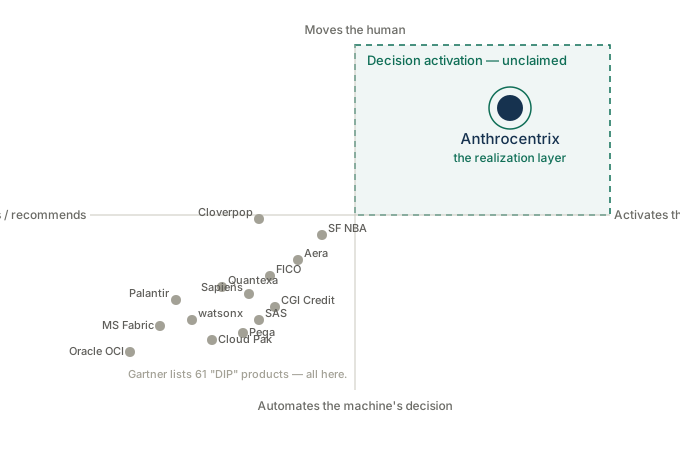
They call a data warehouse “decision intelligence.” We're the part where a person changes what they do.
The engine is domain-neutral. A new decision layer is mostly assembly — the same engine, a different compliant playbook, in any industry where people have to act on a decision.
Nine sectors, fifty-three representative decisions — one engine, one repeatable method.
The Foundry isn't only how Biomavens builds — it's what you can build on. Your team defines the objective, the domain content, and the compliant playbook. Anthrocentrix reads the binding human factor, delivers the matched move, and measures whether the action landed — then learns from the gap. Your data, your tenant, our engine, reached through a hosted door. The engine source never leaves; you get the door, not the code.
Bring us a decision your team can't get to landBuilt for governed environments — tenant isolation, role-based access, auditable decision records, configurable approval gates, and client-controlled data boundaries.
Because recommendations don't fail in theory. They fail in the room.
Biomavens was built from the operating side — three decades of building commercial organizations, standing up new capabilities, launching offerings and turning around teams that had everything they needed and still weren't getting there. Across every one of them the same thing kept happening: the analysis was sound, the recommendation was reasonable, the dashboard was clear, and still the person didn't act.
We are a consultancy that builds. Strategy that never reaches an operation is a deck; a system nobody uses is a cost. The work is the connection between the two — and Anthrocentrix is what came out of doing that work long enough to see the pattern and codify it.
For operational work: four steps, in order. Stop at any of them.
The four steps below are the path for operational work. Start with a free Realization Check on one decision that isn't landing. If it is worth going further, a fixed-fee Decision Build maps your operation and leaves you with something working. A pilot follows only if the Build says it should, and we can run it for you after that.
Commercial strategy and AI product work are scoped on their own terms — get in touch.
What we are not claiming
That this works everywhere, that the engine improves outcomes in your domain before it has been measured in your domain, or that any of it is useful without someone on your side who wants the decision to land. A Build can end in "do not proceed." That is a result.